
When a Mid-Market Company Needs a CTO—and When It Doesn’t
- June 3, 2026
- Posted by: Jeff Andrews
- Categories: Leadership, Technology
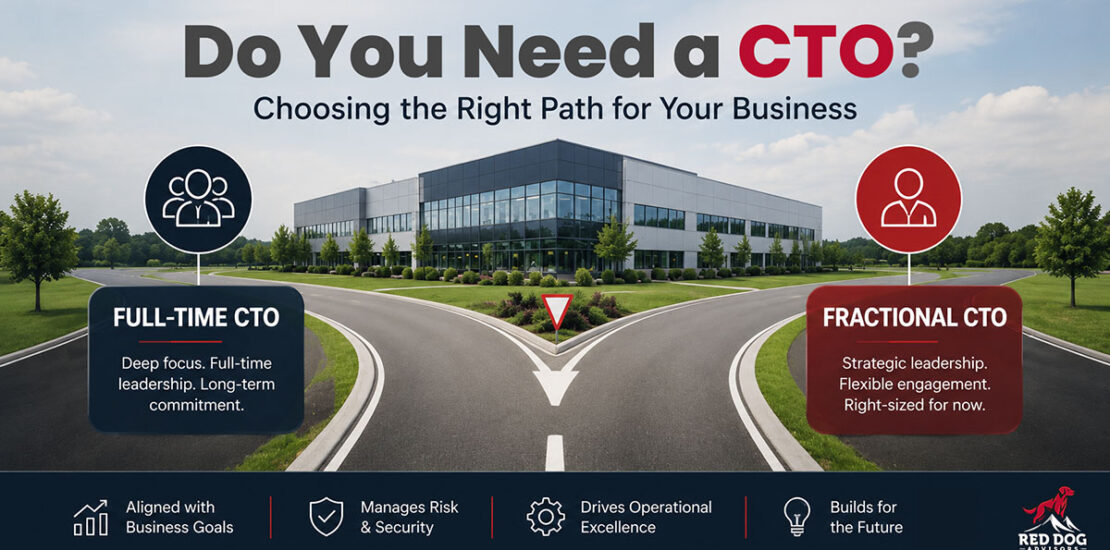
It usually comes up the same way. Revenue crosses some threshold, a board member or an owner asks whether the company should have a CTO, and nobody in the room has a confident answer. So the search starts, a job description gets written by committee, and eighteen months later the company is on its second failed hire—or sometimes they simply haven’t done anything.
The size question isn’t the most relevant one. What actually matters is whether you build technology or buy it, and sometimes how much you’ve put off key technology related decisions.
If technology is your product—if you employ engineers, ship software, and your competitive position depends on what you release next quarter—you need a full-time CTO. The role is a daily job. It involves architecture decisions, engineering culture, hiring and retaining developers, and technical debt that compounds while you sleep. Nobody can do that two days a week.
Most mid-market companies aren’t in that position though. They buy technology. They run an ERP, a CRM, some integrations, a reporting stack, and increasingly some AI tools. The work isn’t building. It’s deciding: what to replace, what to modernize, what to integrate, what to leave alone, what a vendor is actually selling you, and whether the implementation partners we have are any good.
Those decisions are enormously consequential and they don’t arrive daily. They arrive in clusters, a few times a year, and they’re worth millions when handled well.
Here’s a common mid-market scenario. A company that buys technology hires a full-time CTO anyway. Within six months the role has no strategic work to fill a week, so it drifts toward what’s visible and urgent—help desk escalations, laptop procurement, the network. Now you’re paying $250,000 for infrastructure management, and the person you hired is bored and updating their resume. The next CTO inherits a role which has already been defined downward.
The honest alternative is to separate the two jobs. Hire or promote a capable IT manager to run operations, which is a real job and a different one. Then bring in senior technology judgment periodically—for the technology stack assessment, the ERP selection, the modernization roadmap, the AI question, when someone asks “should we build this or buy it”, or determining why the integration project keeps slipping. That’s what fractional leadership is for.
Signals that you’ve outgrown the fractional model and should hire full-time: you’ve started employing developers (for the right reasons), technology decisions have become weekly rather than quarterly, or you’re running a portfolio of concurrent high-level projects that each need an owner. When those show up, hire. Until they do, a full-time CTO is an expensive way to buy something you really just need in bursts.
The worst outcome isn’t hiring the wrong way. It’s making six-figure systems decisions with nobody qualified in the room, which is where a lot of mid-market companies quietly sit right now.
If you’re curious and want to have a conversation about your situation, review our fractional CTO service or give me a call.